iPhone Duo Camera: How Good Is It? View Sample Photos
During its keynote this week, Apple announced its first-ever foldable iPhone. It is also the most expensive iPhone ever. However, the device has something in common with the most affordable iPhone in the lineup, the iPhone 17e. Both feature a 48MP Fusion main camera.
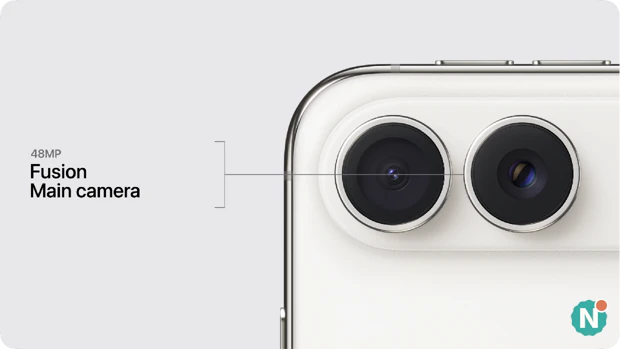
Same main camera as iPhone 17e, not same camera system
It is a 48MP Fusion camera with a 26mm focal length, f/1.6 aperture with sensor-shift and Hybrid Focus Pixels. Zooming is done on the sensor at up to 2x, which yields 12MP photos with a 52mm focal length. The list of camera specs is stated on both the iPhone Duo and the iPhone 17e. The price difference, however, is enormous: the iPhone Duo starts at 2,339 euros, the iPhone 17e at 719 euros. What the Duo does have extra: a second 48MP Fusion camera as an ultra-wide-angle with macro function, and 4K video at 120 frames per second. So for the main camera itself, you do not pay a cent more than with the 17e.
In theory, both phones take the same photos, but that does not have to be the case in practice. That is because a large part of the image quality is determined by the software. Although Apple claims on both specification pages to use Deep Fusion and Photonic Engine, we do not rule out that the A20 Pro chip in the iPhone Duo can handle just a bit more image processing than the A19 chip in the iPhone 17e.
Sample photos of the iPhone Duo
And because a picture says more than a thousand words, we prefer to show you the photos that the iPhone Duo has taken. You see them below. The first four were taken with the main camera, the last two with the ultra-wide-angle.








The images above are from Apple itself and were therefore taken under the most ideal conditions by professionals. Results at home will undoubtedly be less.
New camera features thanks to the external display
What does make the Duo different as a camera than a regular iPhone are the two screens. Apple built a series of features around them. With Duo Preview, the person you are photographing sees themselves live on the external display, so they can see for themselves if they are framed well.
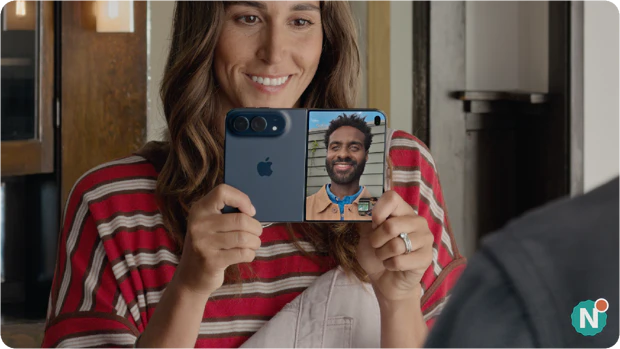
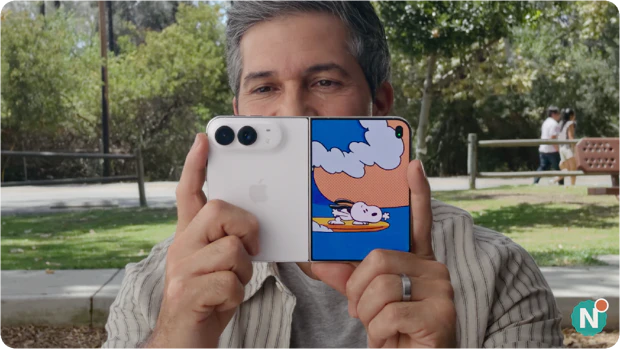
Blikvanger shows an animation on that same external display, which according to Apple draws the attention of the person you are photographing to the lens. Slimme Foto takes a photo automatically as soon as the Duo notices that everyone is ready. And because you watch along on the external display, you simply take selfies with the much better cameras on the back. Whether Blikvanger and Slimme Foto work as well in practice as Apple promises, a test must show.
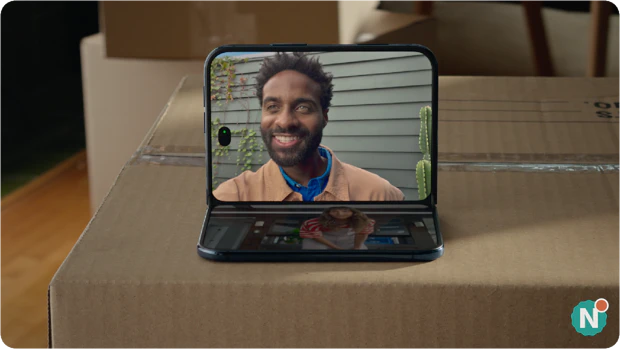
Half unfolded, the device stands on the table like a laptop, which Apple calls Handsfree FaceTime; with Duo FaceTime, bystanders talk along via the external display.
Selfie camera under the screen is the weak spot
Apple gave no sample photos taken with the inner selfie camera. Possibly for a reason. Apple mentions no resolution for the camera under the inner screen, only an f/1.8 aperture and video up to 1080p. Moreover, the camera remains visible as a shiny dot in the screen because the anti-reflective layer of the inner screen is missing there, as hands-on videos show.
Examples we have seen are in line with what the camera under the screen of the Galaxy Z Fold series has shown for years: not very good. That does not have to be problematic. You take photos mainly with the cameras on the back anyway, and in the outer screen there is still a regular 12MP Center Stage camera for selfies. What remains is that you use that inner selfie camera mainly for FaceTime video calling, where image quality is less important.
If you buy a phone for the camera, the Duo is not your device: the same main camera is in an iPhone 17e for a fraction of the price, and an iPhone 17 Pro has a real telephoto lens. You buy the Duo for the foldable screen.