Favorites

You haven't found any favorite products yet!

Explore the products on our website and click on the heart icon to add products to this favorites list.

Start exploring
Nieuwemobiel Page Image

Buy a Power Station

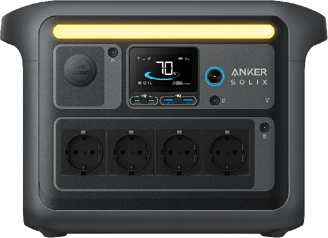
A power station is a large portable battery with a real 230V outlet, designed for camping, RVs, festival grounds, and power outages at home. Here you’ll find all portable power stations, from compact models for a weekend to heavy-duty units that can power a refrigerator. Let’s be honest: if you just want to charge your phone or tablet on the go, a power bank is a cheaper and lighter option. We compare current prices from all retailers, 100% independently. Use the filters for capacity, power output, and ports to instantly find the power station that fits your plans.

Nieuwemobiel Page Image
Found: 1 power stations

What should you look for in a power station?

Two numbers: the capacity in watt-hours (Wh) and the power output in watts (W). Capacity determines how long you’ll have power, while power output determines what you can plug into it. Only then do the connections, charging options, and weight come into play. A power station that stores 2,000 Wh but doesn’t provide enough continuous power for your kettle is still the wrong choice for that purpose.

Wh is the unit of measurement, not mAh

A power station expresses its capacity in watt-hours, and the calculation is simple: energy (Wh) equals power (W) times time (h). A 50-watt device will run on a 500 Wh battery for roughly ten hours, minus the loss from the inverter. Power banks usually list mAh, a number that only makes sense when combined with the voltage. Wh is therefore the fairer metric for comparing models side by side.

The difference from a power bank

Three things set it apart. A power station has a real 230V outlet, so even devices without a USB connection can be powered by it. It has an input for a solar panel, allowing you to recharge without an outlet. And its capacity is an order of magnitude higher than that of a power bank. On the other hand, a power station is many times heavier and more expensive.

For most people, a power bank is sufficient. If you just want to charge your phone, tablet, or earbuds at a festival or on a flight, don’t buy a power station. It only becomes useful if you want to power a cooler, lights, power tools, a medical device, or your boiler during a power outage.

Power: What Can You Actually Plug In?

Look at the continuous power output in watts, not the peak value, which is often listed as a higher number on the box. Devices that generate heat—such as a kettle, hair dryer, microwave, or coffee maker—require much more power than those that don’t. Look up your device’s wattage—it’s listed on the nameplate or in the manual—and compare it to the power station’s continuous power output. A laptop, lights, a cooler, or charging phones is rarely a problem; anything that generates heat, however, is.

Account for losses, weight, and price

The inverter that converts battery power to 230V consumes energy itself: expect about a 15 percent loss (Campingtrend). Therefore, charge phones and laptops directly via the power station’s USB-C port; this way, the inverter won’t kick in, and you’ll get more out of the same battery.

Moreover, more Wh always means more weight and a higher price. That’s the key trade-off with this product: capacity versus portability. Check the weight in the specifications before you order, and be honest with yourself about whether you’ll actually take it with you or if it’ll just sit in the shed.

Charging: outlet, car, or solar panel

At home, you can charge a power station from a wall outlet; on the go, you can use your car’s 12V socket or a solar panel. The latter sounds more self-sufficient than it actually is: with a 350-watt panel, fully charging a 2 kWh battery can easily take seven to eight hours of full sunlight. While solar power works great as a supplementary charging method during a week of camping, relying on it as your sole power source in the Netherlands is a gamble.

Power stations are not allowed on airplanes

Lithium batteries over 160 Wh are not allowed on board. For batteries between 100 and 160 Wh, you need prior approval from the airline, and any that are permitted must be carried in your carry-on luggage, not in checked luggage (Inspectorate for the Environment and Transportation). If you’re flying, a power bank under 100 Wh is your only option. Airlines may have stricter rules on top of that, so be sure to check the terms and conditions of your flight.

Alternatives and Add-ons

For most situations while traveling, there’s a lighter and cheaper solution:

  • Power banks: enough for your phone, tablet, and earbuds on the go, and the only thing you’re allowed to bring on the plane
  • Chargers: at a campground with electricity, you often just need a good multi-port charger
  • MiFi routers: internet at the campground or in the RV—one of the devices that works perfectly when plugged into a power station
Top