Energy label: Six out of ten phones earn an A, tablets do not
NVWA now also inspecting online stores and comparison sites; we received a letter too
Starting in June 2025, all new smartphones and tablets, including those sold online, must display an energy label. For a long time, this rule seemed to exist mostly on paper, but the Netherlands Food and Consumer Product Safety Authority (NVWA) is now actively checking whether online retailers and comparison sites are complying. We know this firsthand: NieuweMobiel.NL received a notice as well. Now that all labels are in our database, we have counted them. What does this mean for you as a buyer, and what exactly is on such a label?
NVWA Inspects Online Stores and Comparison Sites
At the end of October, we received an email from the NVWA: the devices on NieuweMobiel.NL were not properly provided with an energy label. We were already displaying the energy class on product pages and linking to the European product database EPREL, but that is not enough. The rules require the label to be visible next to every price, with an arrow in the color of the energy class and the full label one click away. Those who fail to comply are given a deadline to correct the issue, followed by a re-inspection. If the problem persists, a fine may be imposed.
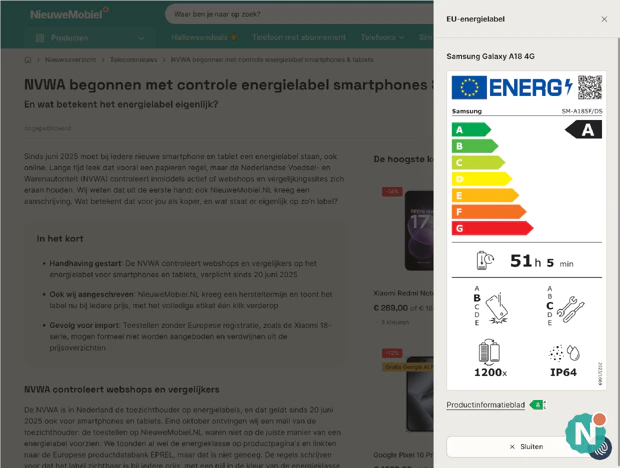
We updated the display within a week: the official EPREL arrow now appears on the product image next to every price, and clicking on it opens the full label. The NVWA confirmed in late October that the display is now correct and subsequently verified its completeness. The official re-inspection was still underway at the time of writing; as soon as the results are known, we will add them here.
What is on a phone's energy label?
When the label became mandatory in June 2025, we already listed the components and noted that we intended to add that data to our database. That went slower than hoped, but everything is now included. A phone’s power consumption is negligible; the label primarily focuses on how long the device lasts.
- Energy classes A to G: based on battery life per charge relative to battery capacity
- Battery life: the number of hours and minutes the device lasts on a single charge, according to a standardized test
- Charge cycles: how many full charge cycles the battery can withstand before it drops below 80 percent of its capacity, with 800 as the legal minimum
- Drop resistance A to E: how many drops onto a hard surface the device can withstand without losing functionality
- Repairability A to E: how easy it is to replace parts and how long software updates and replacement parts remain available
- Dust and water resistance: the IP rating
The QR code on the label takes you to the device’s EPREL registration, where the manufacturer has recorded all test data. This makes it possible, for the first time, to compare devices based on their lifespan rather than just their specifications.
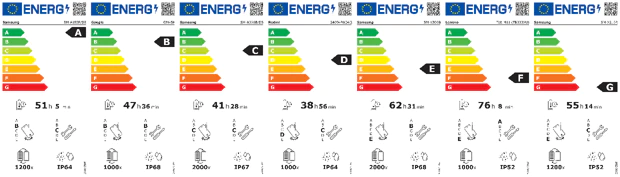
Smartphones overwhelmingly earn an A, tablets almost never do
Now that all registrations are in our database, we can count how the classes are distributed for the first time. For smartphones, the picture is rosy: six out of ten devices with a label earn an A and one-third a B. Scores lower than D do not occur. Even Apple, which complained about the test method last year, earns an A with the iPhone 17 series. For tablets, the picture is exactly the opposite: not a single tablet with a label earns an A or B, and more than three-quarters are at F or G. Why that is the case does not appear from the label itself; presumably, a large screen places such a demand on the battery that tablets consistently lag behind in the calculation method.
| Energy class | Smartphones | Tablets |
|---|---|---|
| A | 60% | 0% |
| B | 34% | 0% |
| C | 4% | 1% |
| D | 2% | 9% |
| E | 0% | 13% |
| F | 0% | 33% |
| G | 0% | 44% |
Distribution of energy classes across all smartphones and tablets with an EPREL registration in the NieuweMobiel database, as of October 30, 2026; devices without a label were excluded
Manufacturers are also visibly steering toward the label. Of the smartphones announced in 2025, 55 percent earned an A; for devices from 2026, that is 74 percent, and C and D no longer appear this year. For tablets, no such improvement is visible: three-quarters of the 2026 tablets are also at F or G. The energy class therefore says less and less about the distinction between smartphones; for tablets, it says a lot.
| Announced | A | B | C or D |
|---|---|---|---|
| through 2024 | 49% | 45% | 6% |
| 2025 | 55% | 35% | 10% |
| 2026 | 74% | 26% | 0% |
Smartphones with an EPREL registration in the NieuweMobiel database, by year of announcement; devices from before 2025 were registered voluntarily after the fact
Why some devices do not have a label
Not every phone in our comparison tool has a label, and that is usually justified: devices from before June 20, 2025, feature phones, and models that are no longer for sale as new do not need one. It is more difficult with imported devices such as the Xiaomi 18 series and the Oppo Find N6, which are not officially released in Europe. The importer is then responsible for the registration in EPREL, and without registration, a device may formally not be offered in the EU.
What this means for you as a buyer
The result of the inspections is that you will increasingly see a complete label at Dutch stores and comparison sites, even for models a year old. If you are buying a smartphone, look past the large letter to the repairability class and the number of charge cycles: those are the figures that determine whether a phone lasts four years or needs to be replaced after two years. If you are buying a tablet, the energy class is indeed a distinguishing criterion, because the differences there range from D to G. And if you see no label at all on a new device, there is a good chance it is an import, with all the consequences for warranty and updates.