Compare Affordable Phones
Affordable phones come in more varieties than you might expect: from handsets that are just for making calls to full-featured entry-level smartphones. In this overview, they’re sorted by price, with the current price listed for each participating store. We don’t earn any more from one device than from another. If you’re not sure which type you’re looking for, read about the differences below the overview.
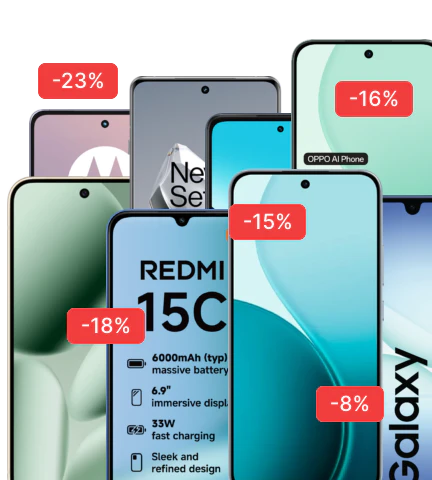
Inexpensive smartphones
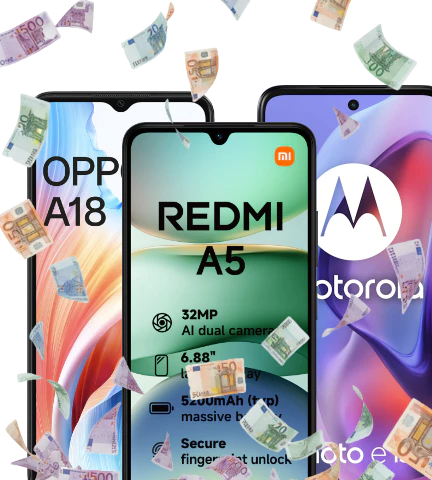
Cell Phone Deals
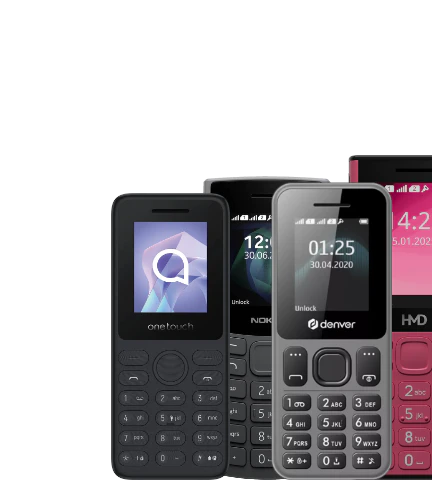
Dumphones
Which affordable phone is right for you?
That depends mainly on what you want to be able to do: just make calls, or also use apps and the internet. That distinction matters more here than the price itself, because the different types vary more from one another than the phones within a single type.
How do budget phones really differ?
- Dumbphones: calls and text messages, long battery life, and no apps—so no distractions either
- Feature phones: can do just a little more, with a calendar, sometimes a radio, games, and on some models a simple camera
- Entry-level smartphones: a full-fledged smartphone with apps, internet, and a video camera, but with slower components; also referred to as low-end smartphones on our site
Senior phones are not a fourth category: they come in two forms—as a basic phone and as a smartphone with a simplified interface. What they have in common are larger buttons, speed dial for favorite contacts, and sometimes an emergency button.
What all devices in this overview have in common: making calls, sending text messages, and being reachable on the Dutch network. The choice, therefore, comes down to what’s on top of that. Keep in mind one thing that really sets this category apart: how long a device will continue to receive software updates. For the cheapest devices, that window is usually shorter, and with a smartphone, this factor carries more weight than with a feature phone without apps, because security updates protect your data on a smartphone.
Choose a dumbphone or feature phone if you mainly want to make calls and charge it as little as possible
Choose an entry-level smartphone if you need apps, maps, the internet, and a camera
Choose a phone with buttons and a menu if simplicity is most important, since senior phones come in both styles
Will you still be reachable with this phone?
This is the most important thing to check with a very inexpensive phone. Older network technologies are being phased out: 3G is no longer in use in the Netherlands, and 2G will eventually be phased out as well. A phone that can’t make calls over 4G currently falls back to 2G for calls, but soon won’t be able to make calls at all—even if the box says it supports 4G. So check whether a phone supports 4G or 5G and whether making calls over 4G (VoLTE) is possible; this information is listed in the specifications.
What do you get—and what don’t you get—in this price range?
You do get: reliable calls and text messages; with basic phones, battery life measured in days rather than hours; and with an entry-level smartphone, the apps you use every day plus a camera for taking photos in daylight. Not included: a fast processor for demanding games, sharp photos in low light, a high refresh rate, or a dust- and water-resistant case. If you want to explore further, budget phones have a fixed upper limit, which is handy if you have a maximum price in mind. Cheap smartphones shows only smartphones, without any basic models mixed in.
