
Your Child’s First Phone
Which one do you choose, and do you even need one?
Rather than asking, "Which phone should I get for my child?" you should ask, "What problem am I trying to solve?" Do you want to be able to reach your child and know where they are? Or do they need to keep up with the class? Two of those three scenarios don't require a smartphone. If it does end up being a phone, you’re probably thinking of a basic phone. However, you can also completely lock down a smartphone. This buyer's guide walks you through the options, from smartwatches to restricted smartphones, and helps you choose what's best for your child.
Why First Phone Is Bigger Step Than You Think
Giving a phone feels like a small gift, but you open up a whole world with it. Especially with a smartphone: it provides not only reachability, but also an open window to the internet, group apps, games, and soon social media. And that is exactly where the risk lies.
Research has become robust in recent years. A large-scale study in the journal Pediatrics (early 2026) links a smartphone at a young age to a demonstrably higher risk of depressive symptoms, obesity, and sleep problems. Blue light can inhibit melatonin production for some time, leading to later bedtimes and poorer sleep. Added to this are concentration problems, peer pressure in app groups, and unwanted contact.
Concern is widespread. In May 2025, a collective of around 1,400 doctors and scientists, united in Smartphone-Free Upbringing and supported by more than 50,000 parents, called on policymakers for a minimum age of 14 for a first smartphone and 16 for social media. That is even stricter than the later government advice. The message is not that a phone should be banned, but that "too early and too much" is harmful, and that you should therefore take that step consciously and as late as reasonable.
That doesn't mean your child shouldn't be reachable. It means you can separate the function (contact & safety) from the device (a full smartphone). Often, much less is enough.
Wait a little longer if the only real reason is "everyone has one", or if your child still has trouble with agreements and self-control. Delaying is not a punishment; it saves years of worry.
Do start if there is a concrete need (going to school alone, sports, being reachable) and you consciously choose the lightest device that covers that need.
What Do You Actually Want to Solve?
Before looking at devices, this is the most important question. Most parents want one of these three things, and each requires something different.
Reachability. You want to be able to call your child and be called, for example, when they go to school or a club independently. A smartwatch with calling function or a simple phone is sufficient for this. No internet needed.
Knowing where your child is. You mainly want peace of mind: did they arrive safely? Then you are actually looking for location, not communication. A GPS smartwatch or a standalone GPS tracker is made for this.
Social participation. The class apps via a group, friends meet up online. Only here does a device with WhatsApp (and thus a smartphone) come into play. And this is exactly the need associated with the most risks.
- Do I want to be able to reach my child?
Smartwatch with calling function or a dumbphone. - Do I want to know where my child is?
GPS smartwatch or standalone GPS tracker. - Does my child need to be able to participate online?
Restricted smartphone, and only when your child is ready for it.
Alternatives Before Starting With Phone
For "reachable" and "findable", a phone is often overkill. Two alternatives do the job without the open internet world.
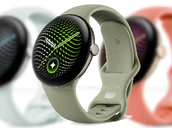
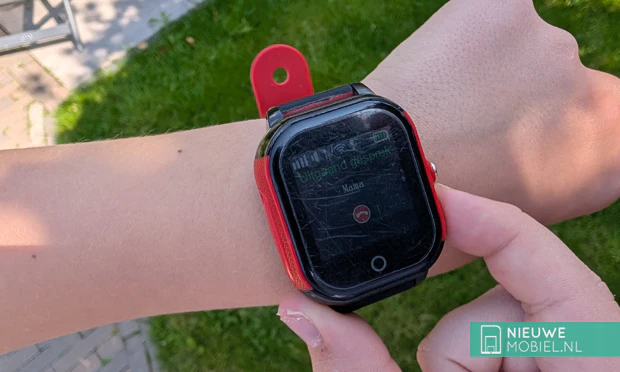
The kids' smartwatch. A watch with which your child can call a fixed list of contacts or send a voice message, plus live location and an SOS button. No open internet, no app store, no social media. Popular choices are the One2track Connect Up and the Garmin Bounce 2 (around 260 euros plus a mandatory subscription of around 11 euros per month, and with 5 ATM one of the few that is truly suitable for swimming). A Dutch brand like One2Track (servers in Apeldoorn, no fixed subscription) is interesting for those who want to watch monthly costs.
The standalone GPS tracker. Do you only want location, without your child having to operate anything? Then you put a tracker in the backpack or jacket pocket. Options like the PAJ Easy Finder 4G or the Invoxia (works on the LoRa network, without SIM card) are made for this.
Note one common misconception: an Apple AirTag is not suitable for this. Apple itself explicitly says that an AirTag is intended to find things, not to track people or children. There is no live GPS, no calling function, and no SOS button, and the device actually actively warns the wearer that an "unknown" tracker is traveling with them. To track your child, choose a real child tracker or smartwatch; keep an AirTag for your keys and suitcase.
Choose a smartwatch if your child needs to be reachable and findable and wants to be able to call themselves. All-in-one, visible on the wrist.
Choose a standalone tracker if you purely want location and the device needs to be invisible and low-maintenance, without your child having to do anything.
If You Choose Phone Anyway: Dumbphone Over Smartphone
If a real phone turns out to be necessary, our advice is clear: for a child, choose a dumbphone rather than a smartphone. This aligns with the advice of doctors and government, and it saves you a mountain of worry. A smartphone is possible, but then as a conscious, locked-down exception.
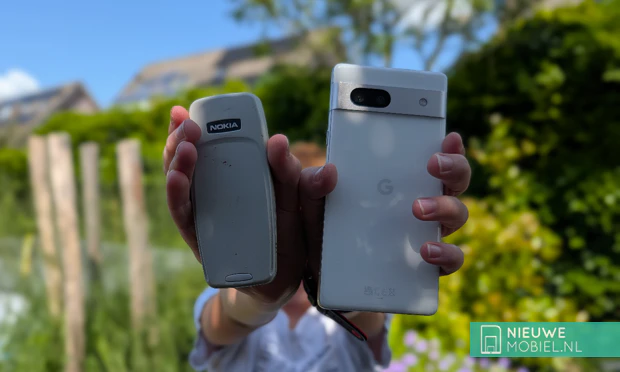
The dumbphone (feature phone): our preference. This is probably the image you have in mind: a device that calls and texts, perhaps with a small camera and a radio, and little else. A modern Nokia 105 4G or an HMD model simply works on the current network, lasts for days on a battery charge, and is indestructible. Hardly any peer pressure and for children the most honest, safest phone. Two things to know: most real dumbphones do not run WhatsApp, so if your child needs to join the class group, you will run into that. And pay attention to the model: some devices (especially those on KaiOS) still have a simple internet browser and sometimes a mini app store, with which you can theoretically access Facebook or YouTube. If you really want it closed, choose a model without a browser, or turn off the browser and data.
The restricted smartphone: only if you consciously want it. We do not recommend a smartphone for a child, but you are of course free to choose one anyway, for example if your child in secondary school really cannot do without WhatsApp. Then do it right: completely lock down the device with parental controls. No app store without permission, screen time limits, filters, only calling, and a few allowed apps. This way you turn it into a "bare" phone in practice, with the option to grow later. An entry-level model or a refurbished device is sufficient; you don't need to buy an expensive phone for this. In the next section, you can read exactly how to set that up.
| Type | Calls/SMS | Location | Open internet | Suitable for | |
|---|---|---|---|---|---|
| Kids' smartwatch | Yes (fixed list) | Yes | No | No | approx. 5-9 years |
| Dumbphone | Yes | Limited | Usually not | Sometimes (browser) | approx. 9-12 years |
| Restricted smartphone | Yes | Yes | Yes | Only what you allow | 8th grade / secondary school |

Editor-in-Chief
As the founder of NewMobile, Martijn is responsible for the technical and strategic development of the platform. With a background in ICT, he developed the website independently from its inception in 2002 and continues to maintain it to this day.