
EU threatens US with €93 billion counter levies, will your iPhone get more expensiv
The European Union is preparing a €93 billion counter-tax in response to the 10% tariff imposed by the US on some member states. This will make American products more expensive for Europeans to buy. Read why your next iPhone may soon be unaffordable (and what you can do about it now).
The package of countermeasures includes products such as jeans, cosmetics and American whiskey. These are mostly products from states owned by Republicans. The hope is that they can put pressure on the president. The package had been ready since June 2025, when President Trump announced levies. However, the EU temporarily paused the plan so as not to thwart negotiations.

Cell phones are not in the package of European measures. In particular, it is iPhones that come from the US, even though they are assembled in China, Vietnam and India. Still, it is not inconceivable that iPhones could eventually be hit as well if the trade war between the two powers escalates. Something analysts do take into account.
Scenario 1: iPhone 17 price rises to €1114
The first scenario is that the EU decides to add iPhones to the package of measures. A levy of between 10% and 25% is then not inconceivable, meaning that the selling price will rise. The price of an iPhone 17 then goes from €969 to a maximum of €1114. And a Pro model then goes through the psychological limit of €1500.

You can get ahead of this by quickly buying another new iPhone.
An extra price on top of the retail price makes Apple's pricing strategy not work anymore. A new iPhone 17 will then no longer be available under a thousand euros, unless Apple will bear some of the cost itself. Although Apple has borne the cost of levies itself in the past, it is more nuanced here. Back then, it was American levies that Apple did not pass on to consumers, mainly to keep Trump in good graces. I have been closely following iPhone pricing trends for 20 years and can't imagine Apple will accommodate European consumers this time around.
Scenario 2: More expensive services
Apple's walled-garden ensures that Apple not only makes good money from selling iPhones, it also makes big money from selling additional services. Think iCloud storage, Apple Music and TV and even the App Store. If Apple has less revenue from Europe as a result of a possible iPhone charge, the cost of these types of services here could be increased. Thus, current iPhone users will also be affected.
Scenario 3: Service interruption(s)
Should the EU-U.S. trade war escalate, Apple might well interrupt access to Apple's cloud services by order of the U.S. government. A day of no app updates is annoying, but what if you can't access your mail for a month? That this scenario is not unthinkable was demonstrated in May 2025. Microsoft then blocked the mail access of the chief prosecutor of the International Criminal Court (ICC) in The Hague.
Plus points of the trade war
Apart from the doomsday scenarios described here, there are also plus points. For example, Mother Nature won't mind skipping a new iPhone cycle. Instead of 2 years, do 3 years on your phone, who knows how the flag will be then?
Want to get ahead of the price increase?
Refurbished iPhones are stable in value.
Refurbished iPhones will do well when the price of new iPhones will rise. Additional benefit of a refreshed iPhone: your money is not going to American Apple.
Focus on possible alternatives
All in all, these promise to be uncertain times. Will you wait and see or make your move now? For example, orient yourself to alternatives. For example, there are European manufacturers of phones. These mostly run Android, which is made and maintained by Google. That, too, is American and would theoretically fall under the same scenarios described above.
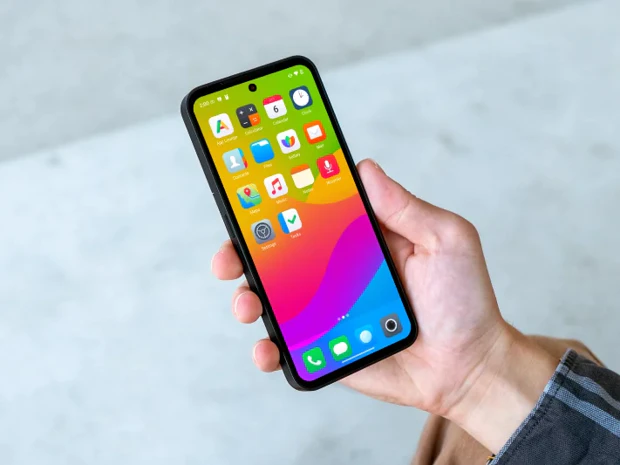
Major exception is the Fairphone Gen 6 with /e/os. That is an open source operating system that can run most Android apps, but does not use Google services. Should Android be sanctioned, this device won't be affected, while you can still do online banking and store photos in the cloud as usual.