
Leaving your phone charger plugged in: wise or not?
Does your phone charger use power when there is no phone connected to it? Yes, but less than fifty cents a year. We calculate standby power consumption and explain why the old rule, "Unplug it," no longer applies in 2026.
A USB-C charger manufactured to the EU standard consumes a maximum of 0.21 watts with no phone connected. That works out to about 1.84 kWh per year, or around €0.49 at an average electricity rate of €0.265 per kWh (as of April 2026). Less than one cup of coffee. Consistently unplugging hardly results in any savings, except in a few specific situations that we discuss below.
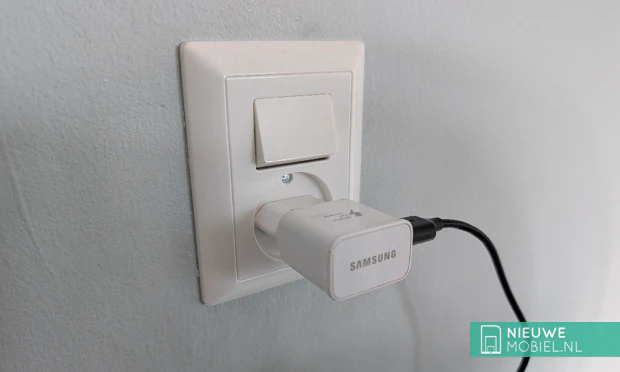
What is phantom power (and does your charger use it)?
Phantom power is the energy a device uses while it is not actively doing anything. In the case of a phone charger, this is because the transformer inside is always on "standby": as soon as you plug in a phone, it can supply power immediately. That readiness takes a minimal amount of energy, even when nothing is connected.
For modern chargers, it's about 0.1 to 0.21 watts. By comparison, a 5-watt LED light already consumes 25 times as much as the most economical charger.
Annual cost of modern charger under 50 cents
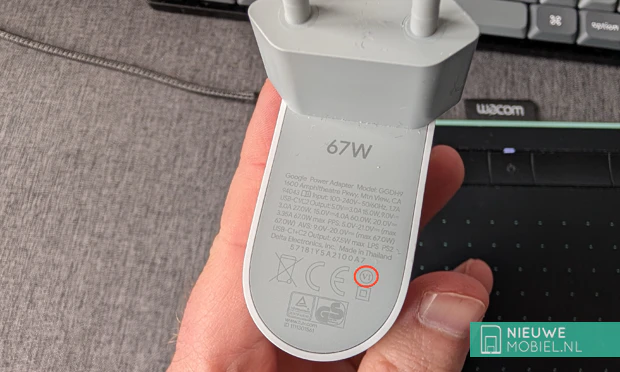
Since 2013, the European Union has limited the standby consumption of new chargers to a maximum of 0.21 watts. Chargers with the V or VI energy label (often found on the bottom of the adapter) are even well below that, at around 0.1 watt.
What that means on your energy bill in 2026:
| Charger type | Standby consumption | Per year (24/7) | Cost per year* |
|---|---|---|---|
| Modern USB-C charger (EU standard) | 0.1 – 0.21 W | 0.88 – 1.84 kWh | €0.23 – €0.49 |
| GaN fast charger (recent) | 0.05 – 0.15 W | 0.44 – 1.31 kWh | €0.12 – €0.35 |
| Old USB-A charger (pre-2013) | 0.5 – 1 W | 4.4 – 8.8 kWh | €1.17 – €2.33 |
| Cheap unbranded charger | 0.3 – 1.5 W | 2.6 – 13 kWh | €0.70 – €3.45 |
*Based on €0.265 per kWh, average variable electricity tariff in the Netherlands, 2026.
Even if you leave five modern chargers permanently plugged in, you stay under €2.50 per year. For most households, that's not worth the effort of unplugging every morning.
Why panic over chargers is outdated
The "pull out your charger" tip dates back to the era of heavy, hot adapter blocks (think: old Nokia or BlackBerry chargers). Those had no detection circuit and remained active. Since the 2013 EU directive and the introduction of USB-C as a universal standard in 2024, chargers have been designed fundamentally differently:
- They have a standby circuit (standby killer) that detects if a device is connected.
- They use GaN (gallium nitride) or more efficient silicon components.
- They are mandatorily compliant with Ecodesign Directive (EU) 2019/1782.
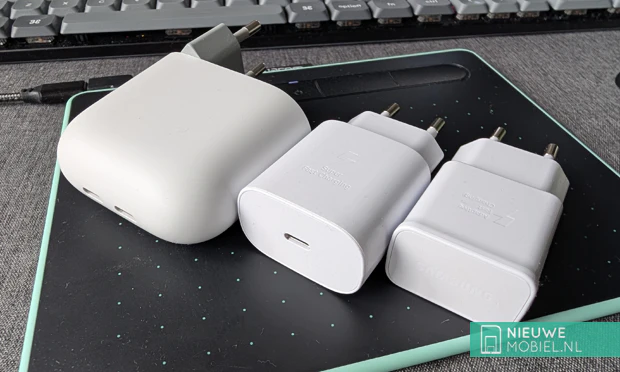
An iPhone charger or Samsung USB C charger in 2026 is no longer comparable to a 2010 charger in terms of standby consumption. The rule of thumb "always pull it out" is technically obsolete.
What wears out faster: leaving it in or unplugging?
A common argument for unplugging is: "otherwise the charger wears out." Is that true? Actually no, because the opposite is equally true; plugging in and unplugging also causes wear, only via a different mechanism.
Wear from leaving it in: the electrolytic capacitors inside the adapter age due to heat. A rule of thumb from electronics is that their lifespan halves for every additional 10°C. With a modern USB-C charger in standby (0.1 – 0.2 watts), the heat generation is so small that the case barely rises above room temperature. Theoretically, this results in a lifespan well above ten years. With GaN chargers, which use ceramic or film capacitors instead of electrolytes, this effect plays even less of a role.
Wear from plugging in and out involves two things: the mechanical connection and the inrush current. A Schuko socket is designed for about 10,000 plug-in cycles and will last 20 to 30 years in a home setting. If you pull it out twice a day, it will last about 14 years. The USB-C side of the charger has about the same limit (10,000 cycles), which in practice is reached sooner because your phone-side also picks up cycles. On top of that, the charger gets a small power-on surge (inrush current) with each insertion; with branded chargers this is absorbed, but with cheap adapters it can cause micro-damage after thousands of cycles.
The net relationship: both mechanisms play out over more than a decade of normal use. For the vast majority of people, neither is the reason the charger fails; it is long since replaced because the phone is updated, the cable fails, or it gets lost. Do you really have to choose? Leaving it in is slightly more beneficial for the USB-C connector on the cable side, while unplugging is slightly more beneficial for the capacitors inside. In practice, the difference is negligible; let convenience be the deciding factor.
When to unplug charger
Fair is fair: there are a few situations when unplugging does make sense. Not because of your energy bill, but purely for safety reasons:
- For old or unbranded chargers. No EU mark = unpredictable standby consumption and a greater risk of overheating.
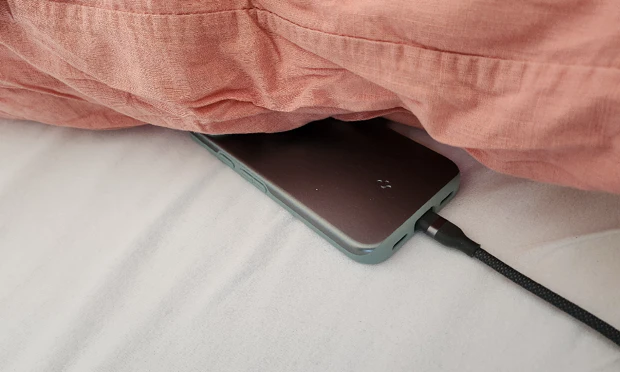
- If the charger is covered by a towel, pillow, or bedding. Heat must be able to escape. Fire caused by a covered charger occurs annually (source: Fire Brigade Netherlands).
- If there is visible damage: frayed cable, bent plug pin, or smell of burnt plastic. Immediately unplug and recycle.
- For longer absences (vacation, business trip). You don't have to, but it also saves with other standby devices, and you can take them with you right away.
For all other times, feel free to leave it plugged in if that's more convenient.
Smart alternatives for saving money
If you're concerned about standby power consumption as a whole, not just your charger, then it pays more to look at the real energy guzzlers: old desktop computers, electric water heaters, underfloor heating pumps running in the summer, or a second refrigerator in the shed. These quickly cost €50 to €100 per year in standby consumption. That's where your bill falls or stands, not with your iPhone charger.
Still eager for a zero-current solution? Three options that require very little effort:
- Power strip with on/off switch. One touch and all your chargers are really off.
- Smart plug (Wi-Fi/Zigbee). Let it turn off automatically after charging, or plan a nightly schedule.
- Multiport GaN charger. One compact charger for phone, tablet, and laptop: fewer plugs, less standby power overall.
Comparison: where you really lose power at home
Some perspective for those worried about phantom power:
| Device | Standby consumption per year | Cost per year* |
|---|---|---|
| Modern phone charger (empty) | 1.8 kWh | €0.49 |
| Smart TV on standby | 15 kWh | €4.00 |
| Wi-Fi router (on 24/7) | 70 kWh | €18.55 |
| Coffee maker with clock | 42 kWh | €11.15 |
| Electric water heater | 150 kWh | €39.75 |
| Old desktop in standby | 260 kWh | €68.90 |
| Floor heating pump (old, on year-round) | 525 kWh | €139.13 |
*At €0.265/kWh. Floor heating pump: 60 W continuous × 8,760 hours, typical for older installations without a pump switch that keep running outside the heating season (source: Regional Energy Desk, Milieu Centraal).
In other words, an old floor heating pump that runs year-round while not actually doing anything useful from May to September will cost you almost 285 times as much as a phone charger that stays plugged in. A pump switch costing around €60 will pay for itself within a year.
Conclusion: just leave it in
For the average user in 2026 with a modern USB-C charger, the old "unplug it" rule is simply obsolete. It costs less than fifty cents a year per charger, and as long as you don't use an old, damaged, or covered adapter, it's perfectly safe. Want to really save on standby consumption? Then focus on your router, your TV, old appliances, or floor heating pump—that's where the real savings are.
About this publication
This data is based on the EU Ecodesign Directive 2019/1782, published figures from Milieu Centraal, Vattenfall, and ANWB, and average Dutch electricity tariffs from CBS for Q1 2026.