
Compare Budget Phones
Budget phones show just how little a usable phone has to cost. This overview includes both touchscreen devices—also known as budget smartphones—and basic phones with a keypad. We don’t earn any more from one brand or model than from another, so the order has nothing to do with our preferences. Set the price filter to the limit you have in mind and compare the options within that selection.
Dumbphones
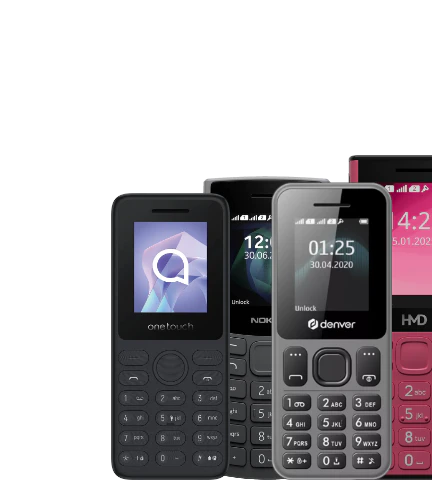
7 products
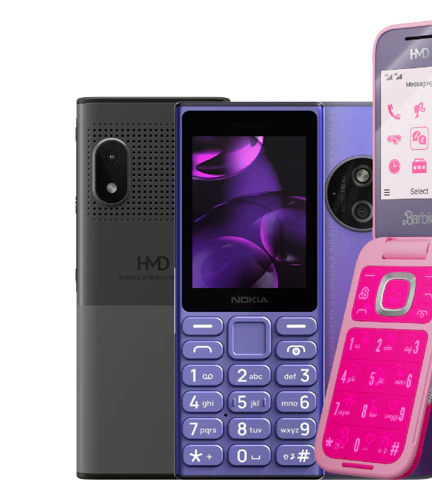
Feature phones
Inexpensive smartphone
What should you look for in a budget phone?
Start by considering what you’ll use the phone for. Simply staying reachable requires different features than a child’s first smartphone, and a second phone to use alongside your work phone requires yet different features. Then compare options within your budget, because in this price range, the differences lie in areas other than those in higher price ranges.
How do budget phones really differ?
The options listed above vary in these areas.
- Phones with keypads: A phone with a numeric keypad lasts days to weeks on a single charge and has no app store or a very limited one.
- Storage and RAM: storage determines how many apps and photos it can hold, while RAM determines how many apps you can keep open at the same time. Both vary significantly by model in this class.
- Battery capacity: This varies widely in this class, and combined with a simpler screen and chip, it results in significantly longer battery life on some models.
- Update cycle: the number of years a device will continue to receive updates varies by brand and model.
- Affordable smartphones: in addition to budget models, you’ll also find options from the next price tier that fit within your budget.
Every device in this overview can make calls, send messages, and set an alarm. If you want navigation, WhatsApp, video, and a camera for everyday use, look for devices with a touchscreen. So your choice comes down first to that difference, and then to how many years you want the device to last.
Choose a phone with physical keys if you only want to make calls and send texts and want to get the longest possible battery life on a single charge.
Choose a budget phone with a touchscreen if you need apps like WhatsApp, navigation, and video.
Choose a mid-range model from last year if you want to keep the phone for more than two or three years and one fits within your budget.
What you’ll have to compromise on in this category
A low price requires compromises, and manufacturers make them in predictable areas: a simpler camera, less storage and RAM, a screen that’s harder to read in sunlight, and a plastic body. So don’t expect a camera phone in this class that’s suitable for a concert or low-light conditions. The most noticeable consequence comes later: after a few years of apps and updates, a phone with little RAM feels slower than it did the day you unboxed it. That’s also why you should take storage and RAM more seriously here than the megapixel count on the box.
A mid-range model from last year
The approach that often pays off more than a new budget model: go for the mid-range device from a year earlier, which has dropped in price following the release of its successor. It usually has a better camera, a better screen, and a faster processor than a new phone in the same price range. Be sure to check how many years of updates are still available. The same applies to a refurbished phone: if you buy it from a professional seller, you’re covered by the legal warranty.
What does the EU energy label tell you about a budget phone?
The EU energy label is the best way to compare budget phones, precisely because their spec sheets are so sparse. Smartphones released in the EU on or after June 20, 2025, carry this label, which lists not only the energy class but also the battery life per charge, the number of charge cycles, the device’s resistance to drops, dust, and water, and a repair class ranging from A to E. Online stores must display the label next to the price. This allows you to compare two devices—even if you don’t know their chip models—based on the same criteria.
How long does a budget phone receive updates?
Don’t assume that every device in this overview will receive updates for five years. That has long been the weak point of this category: a device might still work perfectly fine, but it no longer received security updates. The EU regulations effective as of June 20, 2025, set a minimum standard: updates must remain available for at least five years after a model is discontinued, parts for at least seven years, and the battery must retain at least 80 percent of its original capacity after 800 charging cycles. This rule applies only to models released on or after that date, and it is precisely in this category that models often remain available for a long time. So check the manufacturer’s own commitments for each model, and take that timeframe just as seriously as the specifications.
A simple phone without smartphone features
If you don’t want a smartphone, turn off the touchscreen filter. That will leave you with feature phones and dumb phones: devices with a numeric keypad that let you be reached. A feature phone still has a limited set of functions and apps, while a dumbphone is limited to calls and text messages. There are also models with a rugged casing, which is handy for those who work outdoors.
