Oppo Find X10 Pro Max Official: Three 200-Megapixel Cameras Is Overkill, But Not Everywhere
Oppo unveils new flagship camera phone in China, coming to Europe
Today, Oppo unveiled the Find X10 Pro Max, the standard Find X10, and the Find X10 Lite in China. The top-of-the-line model features three 200-megapixel cameras: a main camera, an ultra-wide-angle lens, and a telephoto lens. Oppo has confirmed that the series will be released outside China, though a release date and price for the Netherlands have not yet been announced. This brings us to the question that accompanies such specs: As a buyer, will you actually benefit from this?
In short: with the telephoto lens, yes; with the ultra-wide-angle lens, hardly at all. Three times 200 megapixels is mostly just a number that looks good on the box. But the device itself is interesting enough to take a closer look.
You don’t actually take 200-megapixel photos
First off: you’ll rarely take a 200-megapixel photo with this phone. By default, the sensor combines sixteen pixels into one large pixel each time, resulting in a 12.5-megapixel photo. This is called pixel binning, and it’s not a trick by Oppo: virtually every phone with a high-megapixel sensor works this way. This merging is necessary because the individual pixels on such a sensor are tiny and capture very little light on their own.
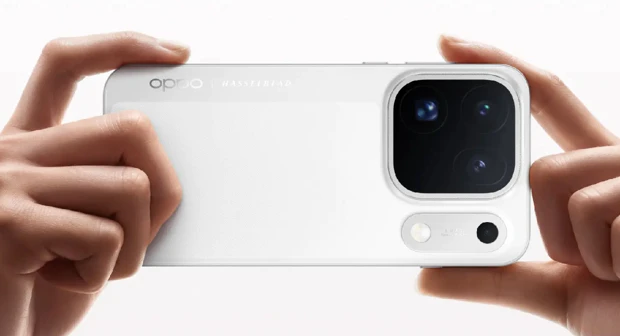
That’s exactly where this design’s weakness lies. The main camera has a 1/1.3-inch sensor, while the ultra-wide-angle and telephoto lenses have to make do with 1/1.56-inch sensors. Those aren’t large sensors for a flagship model, and cramming 200 million pixels onto them doesn’t make them any more light-sensitive. In day-light, the full pixel count provides some extra detail when you enable the special 200MP mode; at dusk, you’ll hardly notice a difference, and you’ll mainly end up with larger file sizes.
The ultra-wide-angle lens: the most unnecessary 200 megapixels
It’s precisely with the ultra-wide-angle lens that the usefulness is lowest. With a 124-degree field of view, you can capture entire streets and rooms, but you rarely zoom in on them. Furthermore, ultra-wide-angle lenses are rarely sharp enough at the edges to truly make use of all those pixels. A 50-megapixel sensor, like the one on the standard Find X10, does the job just as well here.
The telephoto lens: this is where 200 megapixels pay off
It’s different with the telephoto lens, because there you can use the pixels to zoom in without the image falling apart. The lens has a fixed focal length of 70 millimetres, which equates to 3x optical zoom. If the camera crops the centre of the image, you’re left with 50 megapixels at 6x zoom and 12.5 megapixels at 12x zoom—the same as a regular photo. In good lighting, this zoom works without the usual digital distortions, and that is a real added value for anyone who likes to photograph concerts, animals, or architectural details. Another handy feature is that the telephoto lens focuses as close as 10 centimetres, so it doubles as a macro camera.
That telephoto lens isn’t new, by the way: last year’s Find X9 Pro already had one, and it is available in Dutch stores. So if you’re mainly interested in zooming, you don’t need to wait for the Pro Max.
One caveat, though: the standard Find X10 also has a 200-megapixel telephoto lens with 2.8x optical zoom. So you’ll get the biggest camera upgrade with the cheaper model as well. What the Pro Max offers on top of that is a slightly larger zoom step and that 200-megapixel ultra-wide-angle lens—which you’ll miss the least.
What else the Find X10 Pro Max has to offer
Aside from the cameras, the Pro Max stands out mainly for its endurance. The Chinese version has an 8,000 mAh battery. European models with such high capacities often come with a smaller battery, but Oppo kept the Find X9 Pro’s battery in Europe last year just as large as in China. We’ll know for sure once it launches in Europe. Charging is 80 watts via cable and 50 watts wirelessly. According to Oppo, the battery will retain at least 80 percent of its capacity after five years. In addition, the device is rated IP66, IP68, and IP69, meaning it is resistant to submersion and high-pressure jets of hot water.

The screen measures 6.78 inches and refreshes up to 144 times per second, with 3,840 Hz PWM dimming for those sensitive to flickering. Under the hood is the new MediaTek Dimensity 9600 Pro, with up to 16 GB of RAM and up to 1 TB of storage.
When will the Find X10 Pro Max be available in the Netherlands?
That hasn’t been announced yet. In China, the device goes on sale on September 24. Oppo has confirmed that the series will be released worldwide, and a page is already live in the United Kingdom with the message “Coming soon.” According to rumours, the international launch will take place in late October, but Oppo itself has not yet announced a date. The European price and the models that will be available here are also still unknown. As soon as Oppo provides more details, you’ll find them on the product page for the Find X10 Pro Max.